It’s that dull nagging pain at the base of your neck, and sometimes upper back area. Later on, a stiff neck sets in, making simple things like turning your head a struggle, with headaches adding fire to the chaos. Trapezius muscle pain can be more than a daily ache, it can erode your concentration and focus. It’s part of the global neck pain epidemic, which affects as many as 70% of the global population at least once in their lifetime. Trapezius pain is a struggle that millions share, and a problem we often treat at Healthy Movements physiotherapy.
Most of Trapezius pain and tightness is treatable. It mostly boils down to accessing the right treatment and a good plan to avoid reccurrences. Physiotherapy is a critical part of management, with stretches being an essential part of a comprehensive program. This article is about helping you deal with Trap pain with the most effective stretches for the muscle. We’ll set the foundation for understanding these stretches with a quick look at Trapezius muscle anatomy, followed by key causes of pain and tightness. After that, we’ll dive into the most effective at-home stretches to get you started.
Understanding Your Trapezius Muscle
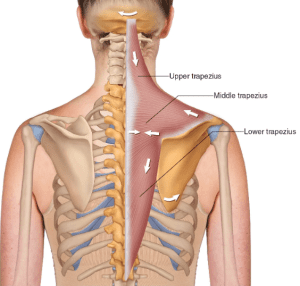
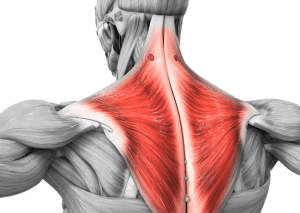
The Trapezius is a large, triangular muscle covering the back of your neck, mid-upper back, and upper parts of the shoulder blade. It has a broad origin, extending from the base of your head, and along the mid-upper parts of the spine. From these origins, it narrows down and inserts into the inner and upper parts of the Shoulder blade.
The muscle has upper, mid and lower sections attached to different parts of the shoulder Blade. When active, each section pulls the Shoulder Blade in different directions:
- The upper part pulls it upwards.
- The mid part retracts the shoulder blade.
- The lower part pulls it downwards.
Apart from moving the Shoulder Blade in different directions, the Trapezius works with other muscles to stabilize and coordinate the Shoulder Blade’s movements with the arm during various activities.
Causes of Tightness and Pain and tightness in Your Traps
There’s a number of potential culprits behind pain in the Trapezius muscle, some within the muscle itself and others from close or remote structures. Let’s take a quick look.
Strains

A strain is a tear within the muscle tissue or tendon(tough connective tissue that connects muscle to bone). It’s caused when a muscle is loaded or stretched beyond its limits. Quick, jerky movements and abrupt heavy loading are common factors.
Once the muscle fibers are torn, special sensory nerves called nociceptors are stimulated through a series of biochemical processes, and this leads to propagation of pain nerve signals to the brain. The pain may be felt immediately or delayed depending on the nature of the injury.
More extensive damage usually causes immediate pain while microscopic tears affecting fewer muscle fibers may take minutes or hours before manifesting as pain. Apart from pain, strains usually come with marked muscle tightness as the body’s reflexive way of protecting the injured area.
Trigger Points
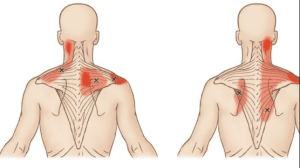
Trigger points are painful, highly sensitive spots within a muscle. They are usually felt as a nodule in a tight band of muscle tissue. They are characterised by intense, localised pain at a specific point in a muscle. Sometimes the pain can radiate to other parts of the muscle and other remote areas when pressured.
Not all trigger points are painful though. Some can linger in muscle tissues without obvious signs, and only cause symptoms when they are provoked by intense pressure. These are called latent trigger points.
Sustained muscle activity due to poor posture and repetitive loading can cause a range of biochemical and physiological changes at a microscopic scale, leading to development of trigger points. Some of the key changes observed by researchers are compromised oxygen supply, shortening of muscle fibres, and a localized inflammatory response in specific areas of the muscle. This gives rise to what we call trigger points.
Irritated Nerves

As indicated earlier, not all Trapezius muscle pain originates from the muscle itself. The muscle is supplied by a bunch of nerves, which activate it and relay sensory information to the Brain and Spinal Cord. It is mainly activated by the Spinal Accessory Nerve, which comes straight from an opening at the base of the skull. Sensory information from the muscle is carried by nerves which pass through small holes in the spine to join the spinal cord in the neck region.
Any structural issues in and around the spine at this region can easily cause pressure/compression on these nerves. This in turn causes irritation and pain along the course of these nerves all the way to the Trapizeus muscle. In addition to pain, irritated nerves tend to show up with extras such as numbness and burning sensations in the Traps and other surrounding areas.
Spasms
A spasm is an involuntary muscle contraction. It may be a short-lived, transient issue or prolonged over a few hours or even days. Like trigger points, muscle spasms can be caused by sustained muscle activity. Sometimes they can be caused by inactivity within the muscle tissue. Prolonged stress or inactivity can compromise local blood flow and supply within a muscle, which leads to accumulation of substances known as metabolites. These substances stimulate sensory nerves within muscle tissue, which trigger a cascade of processes in the nervous system leading to involuntary muscle contractions/spasms.
Psychological Stress

Psychological stress has a profound effect on how the body functions. One of the key effects is that it puts the body in a fight/flight mode through the release of stress hormones i.e Cortisol and Adrenaline/Epinephrine. Epinephrine increases your heart rate, enhances blood flow to your muscles, and triggers a series of biochemical processes to increase muscle activity.
Cortisol helps with boosting energy by increasing supply of Glucose to muscle cells, and interacts with other hormones like Epinephrine to enhance muscle activity. Chronic stress leads to sustained release of these hormones, causing sustained muscle tightness and pain.
Chronic conditions
Trapezius muscle tightness and pain can be a complication of underlying chronic conditions. Some of the major culprits include:
- Cervical Spondylosis: A degenerative spinal condition characterised by wear and tear in spinal structures. These include narrowing of spinal discs, bone structural alterations, and dysfunctional spinal joints. It’s mostly related to aging, but can also be secondary to previous injuries. Pain and compromised spinal mechanics create a cycle of pain and tightness in surrounding muscles, including the Trapezius muscle.
- Fibromyalgia: A chronic condition marked by regional or generalised muscle pains and other symptoms such as fatigue, sleep disturbances and cognitive difficulties.
How Trap Stretches Relieve Pain and Tightness
Stretches and Muscle Tightness/tension
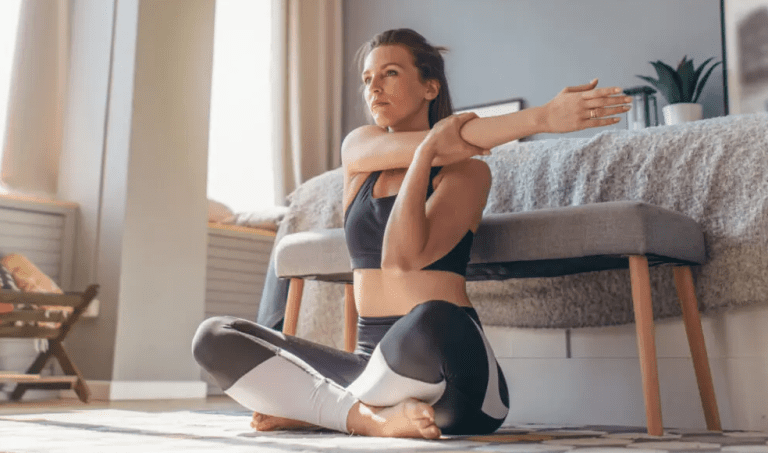
Stretching stimulates special sensory organs in muscle tissues, known as muscle spindles. When this is done long enough, it creates an inhibitory effect in the nervous system which in turn decreases sustained muscle tension. Additionally, stretching helps to lengthen shortened muscles thereby reducing tightness due to shortened muscle fibers.
Stretches and Trap Muscle Pain
Stretches reduce pain in two ways:
- Reducing muscle tension/tightness: Remember, muscle pain can be a direct result of prolonged muscle tension or tightness. Therefore, by reducing muscle tension through the processes discussed above, stretching proves an effective method for pain relief.
- Stretching a muscle stimulates stretch detectors/receptors in the muscle tissue, which send signals to the Spinal Cord. In the Spinal Cord, these signals inhibit transmission of pain signals coming from the target muscle, which translates to pain relief.
Consider this case
A 25 year old lady walked into our clinic a few months ago. Her reason for the visit was clear:
“Please get rid of this stubborn pain and tightness in my neck and shoulders”.
We assured her we would do our best for the help she needed and proceeded to the assessment. She narrated the history of her condition pretty well, and there was no fall, high-impact trauma or previous sickness that may have started the problems.
A deeper dive into her occupation gave us a clue. Her line of work requires her to grind away for more than 6 hours at a desk. The physical exam revealed some postural issues in her upper back and neck area and significant muscle tightness, especially in the Trapezius muscle. Some targeted tests confirmed a diagnosis of Trapezius Myalgia, a Trapezius Muscle Pain Syndrome. She obviously needed Manual Therapy, targeted stretches, corrective exercises and postural education to get better and return to work. The program was carried out for 2 weeks, 3 weekly sessions.
By the 6th session, the pain was completely gone, and stretches were a huge part of it. Upon realizing that her recovery was extremely dependent on her carrying out the home exercise program appropriately, she took Trap stretches and core training very seriously and performed recommended exercises judiciously. In fact, manual therapy techniques which needed our help were only necessary in the first two visits. Beyond that, exercises made all the difference.
5 Best Trap Stretches For Pain and Tightness
Caution: Before diving deep into the stretches. Make sure you clear things up with your physiotherapist, especially when there’re underlying conditions like Spondylosis or disc herniations. Safety should always come first when it comes to taking up any exercise routine.
In need of a full assessment? hit the “make an appointment button” and talk to a seasoned physiotherapist at Healthy Movements Physiotherapy.
Ear-Shoulder Stretch
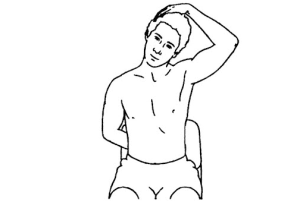
Target Area: Upper Trapezius
How to do it
- Sit down on a stool, bench, or chair. Feet should be flat on the floor, and maintain a straight back.
- Tuck your right arm behind your back.
- Lift your left arm over the head and reach for your left ear.
- Using left right arm, tilt your head to the right until you feel a gentle stretch along the left side of the neck and upper parts of your shoulder blade.
- Hold for 15-20 seconds. Relax.
- Repeat the stretch 2-3 times.
- Repeat the sequence on the other side.
Cross-body Stretch(with Shoulder Protraction)
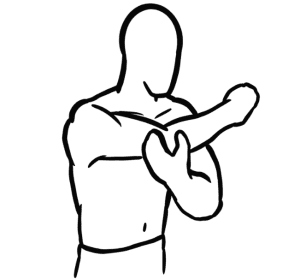
Target Area: Mid Trapezius Area, smaller muscles underneath it, muscles at the back of your shoulder.
How to do it
- Stand up tall, feet at shoulder width apart.
- Raise your reft arm straight up in front to shoulder level.
- Using your left hand, hold your right forearm, just below the elbow.
- Move your left arm inwards across your chest. Use your right hand for extra pressure.
- Draw your shoulder blades forward to add tension to the mid Traps and other muscles in the upper back region.
- Repeat on the other side.
Child’s Pose

Target: Lower and mid Traps
How to do it
- Start with kneeling on all fours, hands below shoulders, knees below your hips.
- Lower your bottom and sit back on your heels.
- Start leaning forward while sliding your hands ahead.
- Keep going until your hands are completely stretched, with your head tucked in, face close to the floor.
- Hold for 15-30 seconds.
- Return to the starting position.
- Repeat for another rep. Aim for 2-3 reps.
Cat Cow
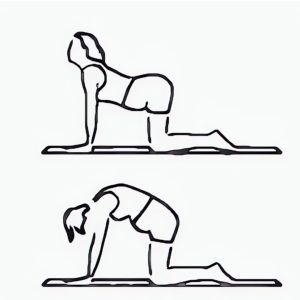
Target area: Mid Traps and lower Traps
How to do it
- Start on all fours. Again, make sure your hands are below your shoulders, knees below your hips.
- Your back should be in a straight position.
- Curl your back upwards, as further up as you can, hold for 2 seconds.
- Reverse the movement, and curl it downwards.
- Repeat the upward curl for another rep.
- Aim for 10-15 reps
Shoulder Circles

Target Area: All-round gentle and dynamic stretching of the Trapezius muscle.
How to do it
- Stand up tall, feet at shoulder width apart.
- Move your shoulders in a circular direction. Keep your arms tucked in to avoid compensation/cheating the movement.
Get in Touch With Us
At Healthy Movements Physiotherapy, we’ve seen it first hand how Trap stretches can be exceptionally effective when it comes to dealing with pain and tightness. A few focused sessions followed by a great home program that empowers you to deal with pain and tightness is often all that’s needed for most patients.
Give us a call today or just hit the “make appointment” button on the top right corner. Our Physiotherapists are ready to bring years of expertise and experience to get you back to what you love to do without limiting pain and stiffness. See you soon.
Frequently Asked Questions
A lot of things can go wrong inside the muscle itself or other areas surrounding it, causing pain and tightness. The most common are Trap muscle strains due to sustained stress on the muscle. Other causes include muscle spasms, pinched spinal nerves supplying the muscle, trigger points, and psychological stress.
Stretches help with pain and tightness through two main ways:
- Lengthening shortened muscle fibres, which restores optimal muscle length.
- Stimulation of stretch sensory nerves known as “stretch receptors” creates an inhibitory effect for transmission of pain signals in the central nervous system.
A great stretching routine for the muscle should target all its three portions. Here are some of the most effective stretches(check for details in the article):
Ear to shoulder stretch: Targets the upper trapezius.
Cat cow stretch: Great for the mid portion.
Child’s Pose: Targets the lower portion.